
Building A Trusted AI Decision Flywheel
AI is moving fast, and one of the best ways to navigate what’s next is to learn from the people actually working through the challenges. In our latest blog, we share key lessons from our Axonis Edge AI Ambassadors on moving AI from ambition to production.
That knowledge needs to be shared for our collective success.
That's the idea behind the Axonis Edge AI Ambassador Program. Our ambassadors bring their experience from the AI frontline into the broader business community, sharing what they're learning, challenging assumptions, and helping establish the practical patterns that can move enterprise AI forward.
As Axonis CEO Todd Barr puts it: “These are the people thinking about how to architect this so it actually works, not just how to make it look good.”
It's a Trusted AI Decision Flywheel: expertise informs implementation. Implementation creates new knowledge. That knowledge is shared, tested, and applied to the next challenge, making every turn of the flywheel stronger.
Since the launch of the Axonis Edge AI Ambassador Program, our global ambassadors have been putting that flywheel into motion, sharing insights into how enterprise AI is transforming our world and practical guidance for navigating this new frontier.
Here are some of the trends, challenges, and transformations they're helping the industry understand.
Bring AI to the Data
For many enterprises, the assumption that data must be moved into a central environment before AI can act on it is becoming increasingly impractical. Agentic AI is designed to reason and act in real time. Waiting for distributed data to be moved, centralized, and cleaned undermines that promise.
We need to bring AI to the data.
Rajesh Kumar, Principal Enterprise Architect at Tata Consulting Service, explored this directly in his blog, Why “Move AI to the Data” Is Becoming the New Enterprise Pattern. As data becomes increasingly distributed across locations, systems and devices, bringing AI closer to where that data already resides offers an alternative to continually moving everything back to a centralised environment.
Dr. Jitendra Bafna, Director, Artificial Intelligence Practice at PhiDimensions, has explored the same shift through the lens of real-time AI in Bringing Intelligence Closer: Why Real-Time Matters at the Edge. In environments where data is constantly being generated, reducing the distance between that data and the intelligence acting on it can make a meaningful difference to how quickly organisations can respond.

Recognizing Patterns at the Edge
When AI is supporting critical infrastructure, intelligence has to arrive fast enough to matter. A flood warning, equipment failure, or other emerging threat can't always wait for data to make a round trip to a centralized environment before action is taken.
Edgar Moran, Senior Software Engineer at Cisco, explored this through a distributed flood-warning system in How a New Flood Warning System Became a Blueprint for IoT at Scale, looking at how local intelligence can support faster responses across geographically dispersed IoT environments

Regulated AI and Healthcare
Healthcare networks and hospitals hold some of the world’s most sensitive and fragmented data. AI has enormous potential to unlock greater intelligence from that data, but doing so raises a fundamental architectural challenge: How can healthcare organizations learn and act across hospitals, systems and patient populations while keeping sensitive data secure, private and under local control?
In Running Clinical AI Without Moving PHI: A Healthcare Architecture Guide, @Rajesh explored how organisations can run AI workloads without moving protected health information away from the environments where it resides.

Jitendra approached the challenge from another angle in Federated AI: How Hospitals Build Smarter AI Together Without Sharing a Single Patient’s Records, looking at how hospitals can build smarter AI together without sharing individual patient records.
Healthcare is a powerful example of a challenge facing every regulated industry: realizing the value of collective intelligence without giving up control of sensitive data.
Security has to travel with AI
The security perimeter changes when intelligence moves beyond the data center and ito distributed systems, applications, and edge environments. If AI can reach the data, the policies protecting that data have to be applied to the AI.
Pooja Kamath, Principal Integrations Architect at Alaska Airlines / API Insights, has explored this in Security Perimeter Stops at the AI Layer. That’s a Problem, looking at why traditional security boundaries can fall short when AI becomes part of the technology stack, and why security needs to extend into the AI layer itself.

Edgar has similarly examined the issue in How to Think About AI Without Centralizing Sensitive Data, exploring how organisations can think about deploying AI without automatically centralising sensitive data.
Thank You to Our Ambassadors
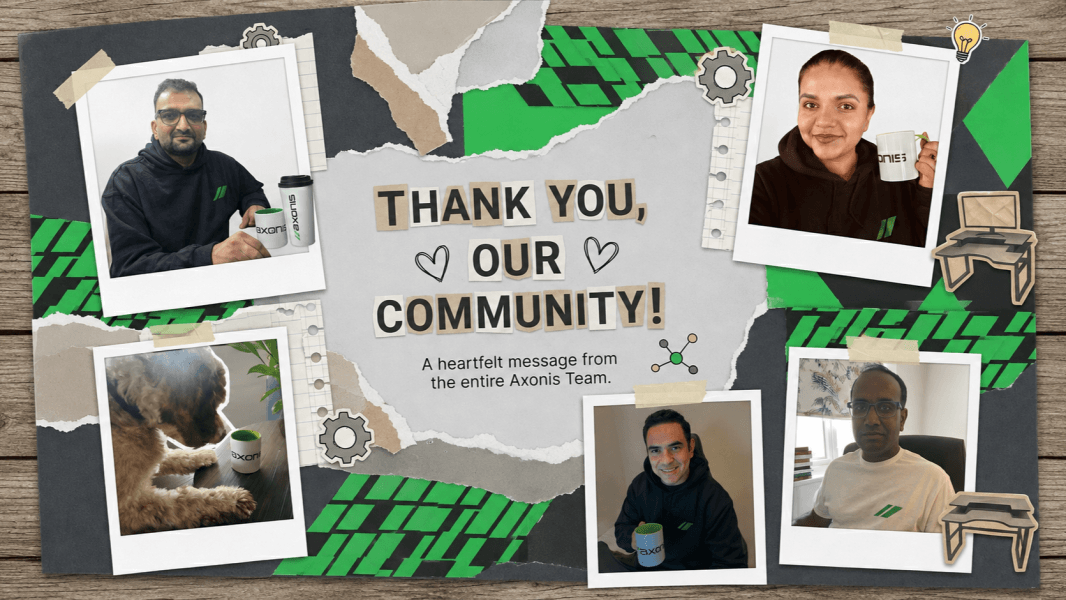
To Edgar, Pooja, Jitendra and Rajesh: thank you for sharing your expertise and perspective with Axonis and the broader AI community.
AI is evolving too quickly for any one company or team to have all the answers. Progress depends on experts willing to share what they're learning, challenge assumptions and bring real-world experience into the conversation.
Your contributions are what put the Trusted AI Decision Flywheel into motion: knowledge shared, ideas challenged, lessons applied and new experience fed back into the community.
“Thank you for being part of it and for helping others navigate this rapidly changing AI frontier. We look forward to continuing the conversation and growing this community of experts.” - Axonis CCO, Sheth Sanket
Learn more about partnerships with Axonis: https://partners.axonis.ai/