
Closing the Sensor-to-Decision Gap in Critical Infrastructure
Critical infrastructure has more sensors than ever, yet decisions still lag. Experts discuss how edge AI and audit-ready decision intelligence close the gap.
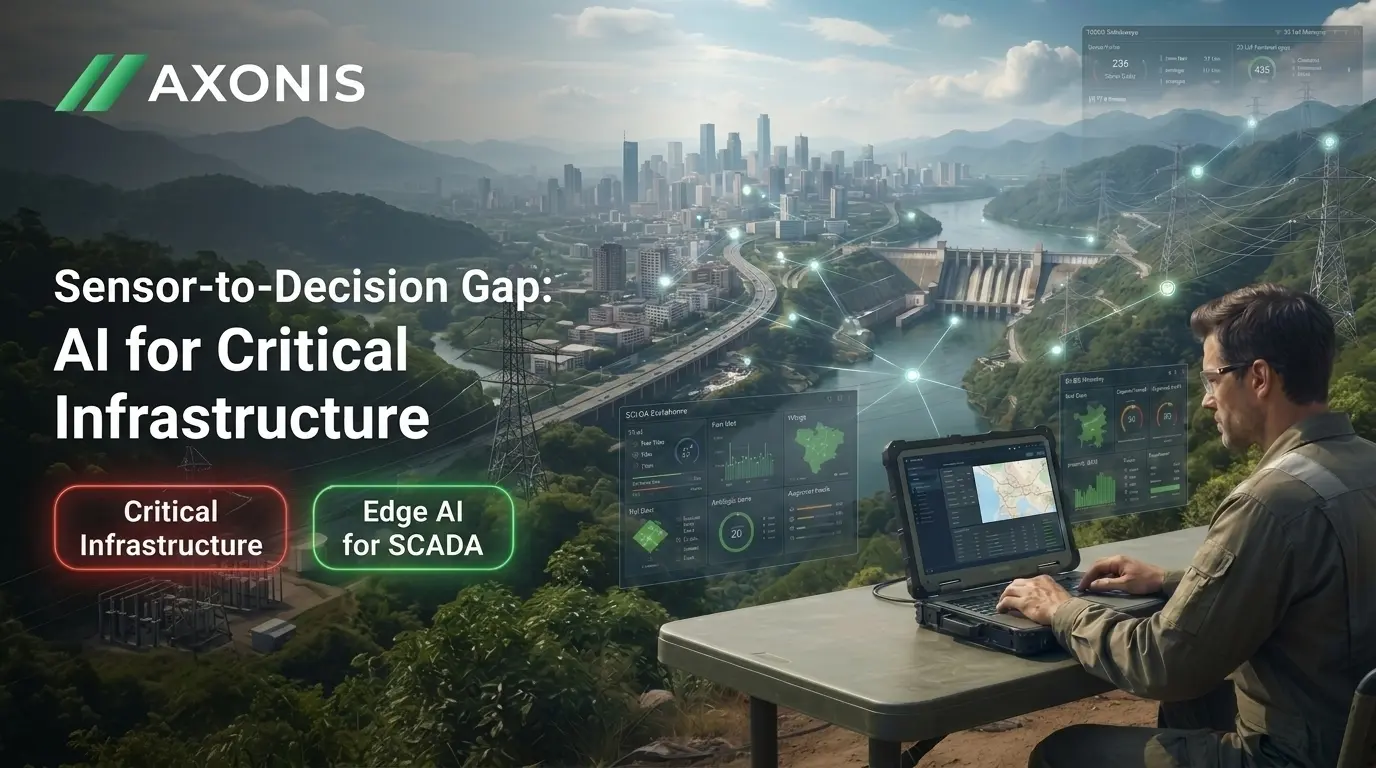
The sensor-to-decision gap is the time between a sensor detecting a change and an operator deciding what to do about it. In critical infrastructure, including water, power, transit, defense and healthcare, that gap is rarely caused by missing data. It is caused by data spread across disconnected monitoring systems, SCADA and IoT feeds, control-room dashboards and separate agencies, which someone has to reconcile by hand, often while conditions are getting worse.
Critical infrastructure operators have more situational awareness tools than ever. Sensors and industrial IoT devices (IIoT) monitor equipment, water levels, operating conditions, security risks, and countless other variables like pressure and access events. Control rooms receive continuous streams of alerts from systems deployed across facilities, networks and geographic regions.
Yet more monitoring has not necessarily led to faster or better decisions.
That was a central theme of Fast Enough to Matter: Closing the Sensor-to-Decision Gap, a panel presented by Axonis and Fierce Sensors. The discussion brought together experts from public safety, defense, healthcare and decision intelligence to examine what happens when sensor growth outpaces an organization’s ability to interpret and act on the resulting data.
The problem is no longer simply a lack of information. It is the fragmentation between the systems collecting that information and the people responsible for making decisions.
Why Control Rooms Struggle to Act on Sensor Data
Most critical environments were not designed as unified systems. New sensors, applications and data sources have been introduced over time, often to address specific operational requirements. Each may work well independently while presenting operators with only one part of a much larger picture.
Readings arrive from SCADA and OT systems, IoT gateways and third-party feeds that were never designed to communicate with one another. When conditions change, teams must reconcile information across separate dashboards, databases and communications channels. Operators may see that an individual threshold has been crossed without immediately understanding what caused it, what else could be affected or how serious the situation may become.
As Axonis CEO Todd Barr explained during the panel, the challenge is no longer collecting data but interpreting it across systems:
“We have more data than we ever even can handle. And if you have all this data coming at an exponential rate, the volume outpaces the judgment you’re able to apply. The patterns that matter for decisions have never been about the data in one silo. It’s whether you can see across the silos.”
In OODA-loop terms—observe, orient, decide and act—organizations have become highly capable at observing. The greater weakness is orientation: understanding what the available signals mean together and determining the appropriate response.
This is particularly difficult when decisions must be made quickly. A delayed response to an equipment fault, security threat or rising water level can turn a manageable event into a service disruption, safety incident or operational crisis.
How Disconnected Monitoring Creates Blind Spots
Simplicity Integration COO and co-founder Allison Reese described how this challenge appears in water and flood management. The necessary data may already exist, but it is distributed across different agencies, jurisdictions and monitoring systems.
An operator assessing potential flooding might need to examine upstream gauges, local rainfall, forecast data, water levels and known thresholds. Looking at any one source in isolation cannot provide the full operational picture. Manually assembling that picture, potentially in the middle of the night while conditions change quickly, costs valuable time.
The same pattern appears across other critical sectors.
In defense, information is distributed among intelligence, operations and other specialized functions. In healthcare, readings and events must be connected to the people, devices, permissions and policies involved. In industrial environments, operators may need to correlate equipment telemetry with maintenance records, environmental conditions and activity elsewhere in the network.
These are not failures of sensing. They are failures to connect and interpret what has already been sensed.
Why More Alerts Cause Alarm Fatigue, Not Better Decisions
The instinctive response to incomplete visibility is often to add another sensor, dashboard or alert. That can make the underlying problem worse.
Every additional feed increases the amount of information operators must evaluate. Without context, alerts create cognitive load rather than clarity. Important signals can become buried among routine notifications, while patterns spanning several systems remain difficult to detect.
The goal should therefore be to improve the journey from signal to decision, not merely increase the number of signals reaching the control room.
AI closes part of that gap by correlating activity across distributed sources, identifying relevant patterns and presenting operators with a more complete assessment. It can support the “orientation” stage of decision-making so people spend less time gathering information and more time determining what action to take.
But speed alone is not enough.
Faster Decisions Must Still Be Defensible
A defensible decision leaves an audit trail an outside reviewer can follow. Take a weather scenario above. When a river gauge crosses weather stages at 2:14 a.m., the decision record should capture:
- Trigger. Which sensor crossed which threshold, and when.
- Correlated signals. The upstream gauges, rainfall readings and forecast data the system evaluated, and the source system each one came from.
- Model and version. What produced the assessment, so it can be re-run or challenged later.
- Policy and decision boundary. The response plan that applied, and what the AI was allowed to do: recommend a road closure, but not order one.
- Human attestation. The named duty officer who approved the action, when, and what they saw at the time.
- Outcome. What happened next, so the record can inform the next decision.
That record is what turns “the AI said so” into an answer a regulator, auditor or after-action review will accept. Todd described the risk of accelerating decisions without preserving that evidence:
“When AI is helping you make more decisions faster, it’s also collapsing a lot of that cognitive load into a black box. You’re at real risk, if you’re using AI without governance, of creating decision debt that becomes a liability when a regulator, government or Congress asks how you made a decision. ‘The model made me do it’ isn’t going to be an acceptable answer. It has to be a defensible decision.”
The panel repeatedly returned to the importance of trust. Before acting on information from another system or organization, an operator needs to know where it came from, whether it is reliable and how it contributed to the recommended response.
Automation can also remove the human witness who once verified an event. Vince Albanese of Haven noted that when a nurse takes a patient’s blood pressure, the organization receives more than a reading. It also receives an implicit attestation of the patient, clinician, device and event. As collection becomes automated, that context must be deliberately preserved.
Effective AI systems therefore need clear decision boundaries, verifiable evidence and named human attestation: a named person who signs off. Operators should be able to interrogate a recommendation, understand what the system evaluated and determine who authorized the action.
Otherwise, organizations may make decisions faster while creating new operational, regulatory and legal liabilities.
From Disconnected Signals to Informed Action
Closing the sensor-to-decision gap does not require organizations to replace their existing infrastructure or move every data source into a centralized environment. In many critical operations, security, jurisdictional and practical constraints make that approach unrealistic.
What organizations need is an intelligence layer that can work across distributed systems—connecting relevant signals, establishing context and preserving the evidence behind every recommendation and action. This gives control-room teams a more complete operational picture while allowing sensitive data to remain where it is governed and trusted.
Axonis runs AI where the data lives, at the edge, on-prem or in air-gapped networks, so sensor data never has to be moved to a central cloud to be analyzed. By maintaining clear decision boundaries and a verifiable record of the data, policies and human authority involved, Axonis helps organizations move faster without sacrificing control or accountability.
The advantage will not belong to the organization with the most sensors or the busiest control room. It will belong to the one that can turn fragmented signals into trusted action—before the window to act closes.
Watch Fast Enough to Matter: Closing the Sensor-to-Decision Gap to hear experts from public safety, defense, healthcare and decision intelligence discuss how organizations can move from disconnected monitoring to faster, defensible decisions. Or book a technical briefing to see how Axonis runs on your sensor data where it already lives.