
The Room Where the Decision Gets Made
A conversation with Col. Yi Se Gwon (Ret.) on cognitive tempo, human judgment and the decision gap at the tactical edge
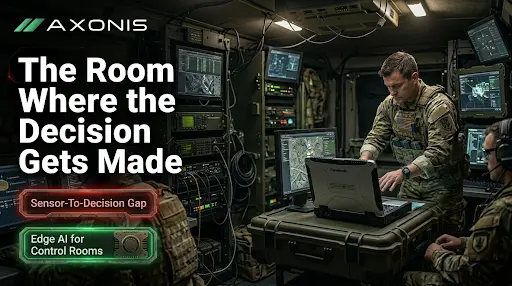
When I think about how military decisions get made today, I picture a room with people from different commands and branches sitting around a table. They're on their phones, gathering information from their teams, coordinating with coalition partners, and trying to piece together what they need to make a decision.
That process depends on people bringing information together and working through the options. But in a world where autonomous systems are operating at machine speed, that approach isn't going to be fast enough.
This is something I've spent a lot of time discussing with Col. Yi Se Gwon (Ret.), a strategic advisor to Axonis and author of The Praxis AI Doctrine – Warfare in the Cognitive Age. Yi Se has spent years working through the operational implications of AI, autonomy, and military decision-making. As he put it during a recent conversation:
"It’s the sensing capability that's outrunning the decision capability."
That observation gets to the heart of one of the biggest challenges facing military operations today: sensing capabilities are advancing faster than the ability to turn that intelligence into decisions.
More sensors, same decision window
Drones, satellites, radar, electronic warfare, and ground sensors give military forces more reach and more information than ever before. Experimentation such as Scarlet Dragon, Operation Jailbreak and Nano ACE reflects the urgency to connect systems, extend sensing capabilities and respond faster.
That work matters. But collecting more data and moving it faster doesn't necessarily mean better decisions. The bottleneck is the time between detecting something and deciding what to do about it. In air defense, that window can be seconds. A perfect decision made after it closes has little value.
And adding more sensors doesn't automatically solve the problem. If the decision-making process stays the same, every new feed becomes another piece of information someone must interpret, prioritize, and reconcile.
Yi Se made an important point about the risk of introducing additional systems without first understanding how they support decisions:
"If you don't address the decision architecture, you're almost compounding the problem."
This is where I believe the Department of War needs to invest as much in decision architecture as it has in data architecture.
Data architecture determines how information moves between systems. Decision architecture determines what happens next: which decisions need to be made, what intelligence they require, who has authority, and how humans and machines work together.
The advantage comes from what Yi Se calls cognitive tempo: the ability to understand, decide, and coordinate faster.
From human in the loop to human judgment in the loop
One of the most important ideas Yi Se and I discussed is how the human role needs to evolve as autonomous systems scale.
Human-in-the-loop is an important principle of military AI, and command accountability is essential. But requiring a human to review every machine-generated recommendation can create a different problem.
Yi Se calls it human-in-the-loop erosion. As the volume of information and decisions increases, the time available for meaningful human review shrinks. Approvals become rushed, context gets missed, and the person supposedly in control may not have enough time to exercise real judgment.
As Yi Se explained:
"If approvals are happening at machine-speed volumes, then the quality of that approval degrades, whether or not you intended for it to or not."
The answer is to keep humans in the process while changing where their judgment is applied.
Yi Se describes this as human judgment in the loop. Commanders establish mission intent, objectives, ethical boundaries, constraints, and decision authorities upfront. AI can then help process information, prioritize what matters, and support decisions within those parameters.
The distinction matters. We shouldn't be asking humans to keep up with every machine action. We should be designing systems around the decisions that require human judgment, with clear authority and controls appropriate to the mission.
Move the intelligence, not the data
There's another architectural assumption worth challenging: that the best way to use AI is to bring all the data into one central location.
Centralized data environments play an important role in enterprise-wide visibility and coordination. But they aren't sufficient when decisions are being made at the tactical edge, where communications may be contested, bandwidth is limited and different organizations cannot freely exchange sensitive information.
At Axonis, we've taken a different approach with Mission Node. Instead of moving all the data to the AI, we bring AI to where the data resides.
Mission Node operates where command decisions are made. It brings together intelligence from sensors, operational systems, historical information and other mission-relevant sources, without requiring everything to be sent to a central cloud.
We configure the system through what we call a mission pack, which aligns the intelligence and AI capabilities with the objectives, constraints and requirements of a particular mission.
And because Mission Nodes can operate as a federation, intelligence can be shared across commands and coalition partners without necessarily exposing the underlying data.
This approach builds on JADC2 and existing enterprise data architecture by adding the decision architecture needed to make that information useful where decisions actually happen.
Trust is built before the battlefield
Yi Se makes a valid point that commanders can't be expected to trust AI without firsthand experience. They need to train with it, question its recommendations, and understand how it reaches conclusions before relying on it in high-pressure situations.
We need to train collaboratively with these systems and then sit down with the engineers for an after-action review. Why did the system tell the formation to go left instead of right? What factors did it consider? That's how we make adjustments, improve the technology and build trust and confidence in its capabilities.
This connects directly to another principle behind Axonis: decisions as data.
Mission Node captures each decision, the supporting evidence, AI models involved and people responsible, creating an auditable record for training and continuous improvement.
Consider a hypothetical military logistics scenario involving a biological threat. AI brings together intelligence from multiple sources, identifies risks and presents courses of action with their trade-offs. The commander decides, and Mission Node preserves the evidence, recommendation and rationale behind that decision.
We're not trying to compress the time commanders spend exercising judgment. We're trying to compress the time it takes to assemble the intelligence they need to exercise it.
With every decision captured, after-action reviews become an opportunity to understand what happened, why decisions were made and how to make the next one better.
The advantage is built now
Yi Se has a line I keep coming back to:
"The force that builds the decision architecture before the next contingency will enter that contingency with an advantage that no rapid procurement can replace."
I think he's right. We can keep adding sensors, connecting systems and deploying more AI. But unless we change how intelligence becomes a decision, we're only solving part of the problem.
The room where the decision gets made is changing. We need to design the architecture that supports it before the next contingency forces us to.
Learn how Axonis Mission Node brings decision intelligence to the tactical edge at axonis.ai/mission-node, and request a complimentary copy of The Praxis AI Doctrine at axonis.ai/defense.