
Centralized Vs Federated Architectures
Enterprise AI has long assumed that better decisions require centralized data. As operational AI emerges, federated architectures are proving a better path, bringing intelligence to distributed data for faster, contextual, and trusted decisions.
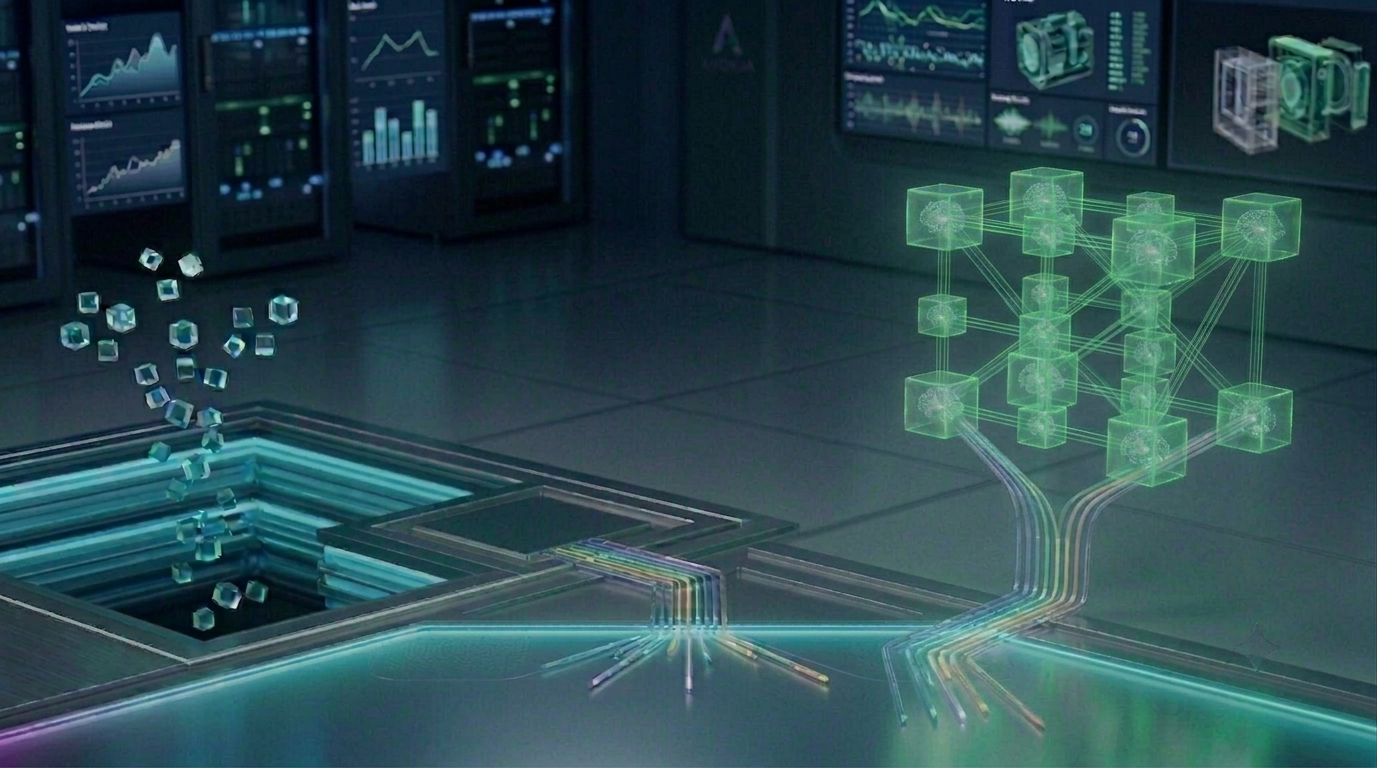
Federated vs. Centralized AI: Why the Future Isn’t Another Data Lake
Matt Malcolm
For most of the last decade, I’ve worked in and led enterprise sales organizations across global accounts, regions, teams, and markets.
In those environments, centralized systems are essential. The CRM gives leadership a shared view of:
- Pipeline and forecast
- Deal value and activity
- Account history
Without that common system, managing a large business becomes guesswork.
But anyone who has managed complex enterprise deals knows the CRM never tells the whole story.
The information that matters most might live in:
- A conversation between an account executive and a customer champion
- Technical feedback or a support issue
- A partner relationship or executive interaction
- A competitive development or a change inside the customer’s business
The information exists. It is simply spread across different people, systems, and teams. By the time it has been summarized, cleaned up, and entered into a central system, the best moment to act may have passed.
That experience taught me something I now see much more broadly: centralizing information and understanding a situation are not the same thing.
Operational AI runs into the same problem at a larger and more technical scale. As AI moves from helping organizations understand what happened to helping them decide what to do next, the architecture behind it has to change. Most large companies already have plenty of data; the harder question is whether intelligence can reach the right information, across the right systems, quickly enough to improve a decision while that decision still matters.
Centralization has a place. Operational AI isn't it.
Centralized data platforms were built for good reasons. They solved the problem of fragmented information across applications, departments, business units, and infrastructure, making reporting more consistent, analysis more complete, and governance easier.
They are still the right tool for specific jobs.
Where it fits (and doesn’t)
Centralization still works well for historical analysis, enterprise reporting, model training, forecasting, and long-term data management. The mistake is assuming it is required for every kind of intelligence, especially when operational decisions depend on live, distributed, or sensitive information that cannot easily be moved.
A platform designed to analyze the past is not always the best place to support a decision that has to be made now.
A System of Record Is Not a System of Decision
This distinction is easy to see in enterprise sales.
A CRM can tell a leader that a large opportunity is expected to close this quarter. It may show the stage, value, last activity, and next step.
But those fields do not answer the questions that usually determine whether the deal is real.
How strong is the champion? Has the economic buyer committed? Is procurement becoming a risk? Did the technical evaluation uncover an issue? Is a competitor gaining ground? Has the customer’s priority changed? Who has the strongest executive relationship, and what should happen next?
The system of record gives you useful information. The decision depends on context.
Sales leaders close that gap through forecast calls, deal reviews, account planning, executive conversations, and cross-functional work. They pull together incomplete signals, test assumptions, challenge the story, and decide what to do.
The same pattern shows up across the enterprise.
- A sensor can report that a threshold has been crossed. It cannot always explain what the reading means.
- A transaction can be flagged as unusual. That does not make it fraudulent.
- A production system can identify an anomaly. It may not know whether that anomaly threatens customer delivery, worker safety, or a critical asset.
The useful insight rarely sits in one application. It comes from understanding how several signals fit together.
Operational AI Raises the Stakes
Operational AI is usually pointed at high‑stakes problems: supply chain disruptions, cyber incidents, manufacturing failures, fraud, infrastructure outages, public‑safety risks. In these moments, delay shows up as lost revenue, downtime, fines, or real‑world harm.
Timing is part of the value.
An insight that lands tomorrow might help with reporting; it rarely prevents the incident. The goal is not to move every record into one place, but to give intelligence quick access to the specific context needed to understand what is happening and decide what to do.
Across domains, the pattern is the same:
- Supply chain: inventory, supplier performance, production, transport, weather, customer commitments, financial exposure.
- Cybersecurity: network telemetry, identity, threat intel, asset criticality, user behavior, business impact.
- Financial crime: customer history, account activity, device and location signals, external risk data, jurisdictional rules.
Most of this information already exists inside the organization or its partners; the hard part is bringing the right pieces together, with enough context and fast enough, to change the outcome instead of just explaining it later.
More Data Does Not Automatically Mean a Better Decision
Enterprise AI conversations often begin with the assumption that better outcomes require more data.
Sometimes they do.
But many consequential decisions fail because the information is
- Fragmented
- Delayed
- Hard to access
- Or missing the context needed to interpret it.
The same thing happens in sales.
Adding more CRM fields does not automatically improve the forecast. Requiring more activity logging does not necessarily reveal the true health of an account. More data can still lead to a weak decision when the information lacks relevance or credibility.
Operational AI works the same way.
The goal should be to:
- identify what matters
- understand how the signals relate
- evaluate the options
- and support action.
In practice, that is difficult because the necessary context may live across cloud platforms, operational systems, edge devices, partner environments, secure networks, and regulated repositories.
When Moving Everything Creates Friction
Not all enterprise data can or should be centralized.
Some information is restricted by privacy, security, ownership, residency, or regulatory requirements. Some is generated at the edge, where connectivity may be limited and latency matters. Some belongs to another organization and cannot simply be copied into a shared platform.
There is also a cost problem.
- Every new pipeline creates more storage, synchronization, governance, security, and maintenance work. Every copy of sensitive information creates another asset that must be protected.
- Companies can spend a great deal of time and money moving and maintaining data before any useful intelligence is applied.
- Forcing every operational AI use case through a centralized architecture can make the system more complicated and slow down decisions.
That is similar to trying to manage a global business entirely through centralized reporting. Leadership needs consistency and visibility, but it also needs intelligence from the people closest to the customer, market, or problem.
You need both.
Bring Intelligence Closer to the Data
Federated AI starts from a practical premise: when data cannot move efficiently or responsibly, bring the intelligence closer to it.
Instead of copying everything into one environment, AI models and agents can operate within or near the systems where the information already lives.
That might mean running inside:
- An organization’s cloud environment,
- On-premises infrastructure,
- Operational network,
- Edge deployment,
- Or a secure environment.
The underlying data stays under the control of the organization that owns it. The system shares only the insights, scores, recommendations, or structured outputs needed to support the decision.
This allows organizations to evaluate information across distributed environments without requiring every participant to give up control of its raw data.
The point is to gain a more complete understanding of the situation without sacrificing speed, security, or governance.
Start With the Decision
Centralized and federated architectures are not mutually exclusive. Most large enterprises will need both.
- Centralized platforms make sense when data can be moved appropriately, latency is manageable, and the use case benefits from bringing large datasets together.
- Federated approaches become more useful when data cannot leave its existing environment, decisions need to happen quickly, multiple organizations contribute to the outcome, local controls must remain in place, or operational and edge systems are involved.
They also matter when a recommendation needs to be traceable later.
The right architecture depends on the decision being supported, not a blanket preference for one technical model.
Put simply, the two approaches optimize for different things:
One Real-World Example
Flood monitoring is a good example.
I grew up in Texas, where flood risk is familiar and conditions can change quickly. Understanding a developing event may require information from field sensors, weather services, upstream rainfall, watershed models, infrastructure maps, historical patterns, and local observations.
No single reading tells the full story.
A water-level sensor may show that conditions are changing, but the meaning of that signal depends on:
- Where it is,
- How quickly the water is rising,
- What is happening upstream,
- What infrastructure is nearby,
- And whether other sources show the same pattern.
Axonis’ work with Simplicity Integration shows how distributed sensor data can contribute to faster, more informed flood intelligence.
The point extends beyond flooding. Organizations do not always need another place to store a signal. They need a better way to interpret it alongside the information that gives it meaning, while there is still time to act.
From Signals to Decisions
The most important shift is not simply where data is stored. It is what happens between a signal and an action.
Most organizations already have databases, dashboards, CRM systems, alerts, analytics platforms, and reporting tools.
What they often lack is a structured way to bring evidence together, evaluate possible actions, account for uncertainty, involve the right people, and preserve a record of why a decision was made.
A useful decision system should help answer a few basic questions:
- What is happening?
- What evidence supports that conclusion?
- What may still be missing?
- What options are available?
- How confident should we be?
- Who needs to approve the action?
- Can we show later why the decision was made?
Those questions matter most in regulated and mission-critical environments, where speed is important but accountability cannot disappear.
Good leaders already make consequential decisions this way. They do not rely on a single field, report, or system. They combine data with context, judgment, competing perspectives, and a clear understanding of the outcome they are trying to achieve.
AI can make that process faster and more consistent, but only when it can reach the information required to support it.
The Future Is Not Another Data Lake Alone
The next phase of enterprise AI will not be won only by the organizations that collect the most information or build the largest central repositories.
It will be won by organizations that can apply intelligence across distributed environments, preserve the controls around their data, and turn fragmented signals into better decisions.
Centralized systems will remain essential. But a system of record is not automatically a system of decision.
As AI becomes more operational, intelligence will need to work closer to where data is created, where events unfold, and where decisions are made.
The future is not another data lake alone.
It is intelligence that can reach the right context at the right time and help people make decisions they can act on, explain, and defend.